Why we built it
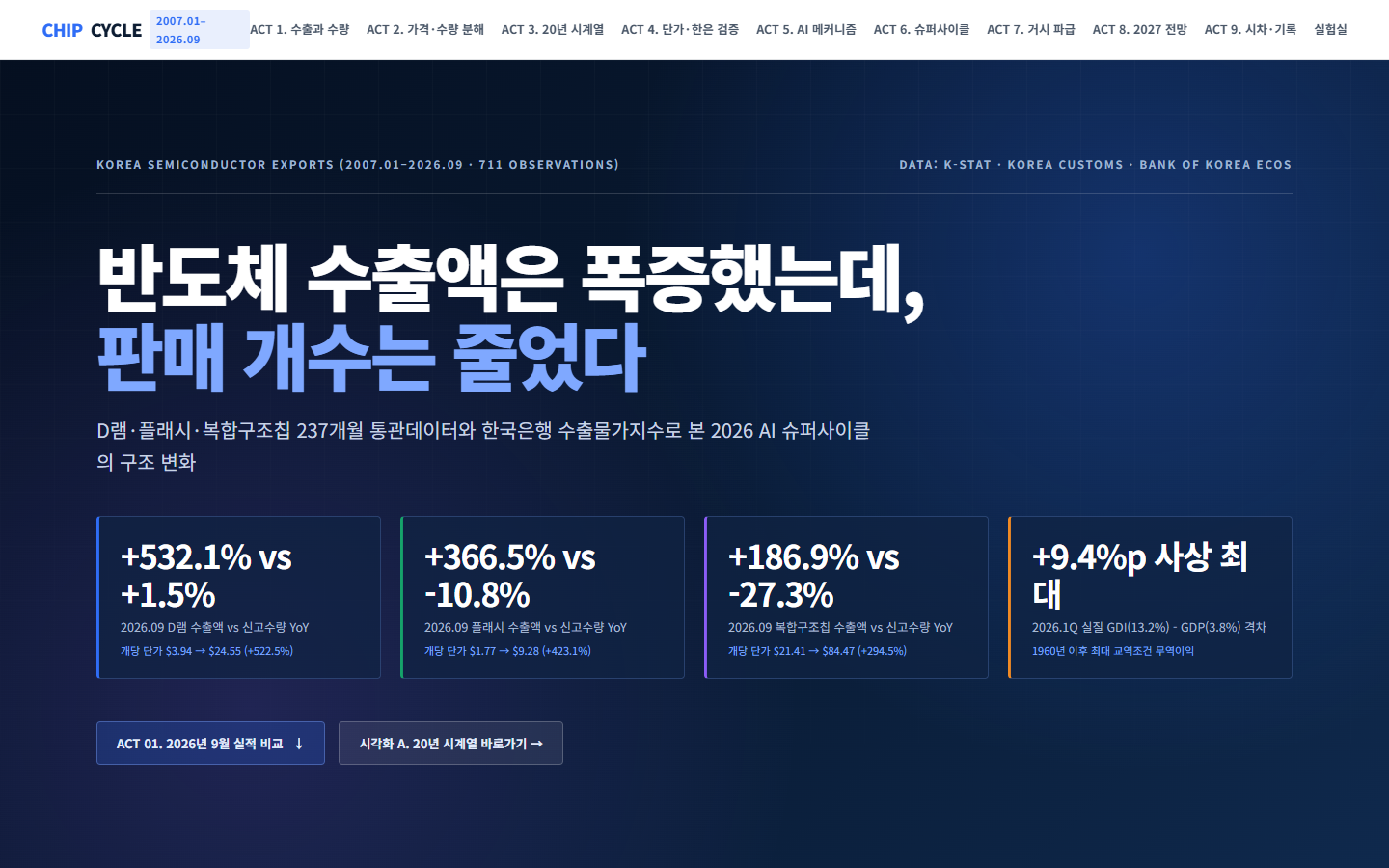
News of record-high semiconductor exports keeps recurring. But it is rarely explained whether the rise in export value comes from selling more or from higher prices.
In September 2026, DRAM export value rose +532% from a year earlier, while declared quantity grew by only +1.5%. Almost all of the export growth came from rising unit prices. We built this to confirm and explain that structure directly from customs data.
Data range: January 2007 – September 2026 (237 months, 711 observations in total). HSK codes for the three main items: DRAM 8542321010, flash 8542321030, multi-chip package 8542323000.
What you can do
View monthly export value, declared quantity and average unit price for DRAM, flash and multi-chip packages across 237 months in interactive charts.
Compare a unit price index based on September 2025 (=100) with the Bank of Korea export price index.
Publishes the results of a Shapley symmetric decomposition that splits the export increase into price and volume effects, along with the formulas used.
Compare the three supercycles of 2017–18, 2021–22 and 2024–26 side by side and analyze the order in which they reached their peaks.
Explains the background of the surge in HSK 8542323000 by strictly separating customs facts from technical and industry interpretation.
Search all 711 observations directly and download them as CSV.
Data and methods
Data integrity: passed the automated validation script covering 12 major checks. Data reference date: September 2026 (latest observation).
How it can be used
In semiconductor export reporting, check with data whether a rise in export value is due to unit prices or volume, and use the charts.
Download the 237 months of raw data as CSV for your own analysis, and review the methodology through the published decomposition formulas.
Understand the relationship between expanding AI investment and changes in semiconductor prices and the export structure through an interactive story.
Technology and how it's made
Raw K-stat .xls and BOK ECOS .csv files are converted to JSON and CSV by a Python pipeline and rendered in a Next.js app. Deployed on Vercel. To rerun the data pipeline: python scripts/build_chip_cycle_data.py.
Development status
Includes observations through September 2026. Updating the data requires rerunning the pipeline and redeploying.