Why we built it
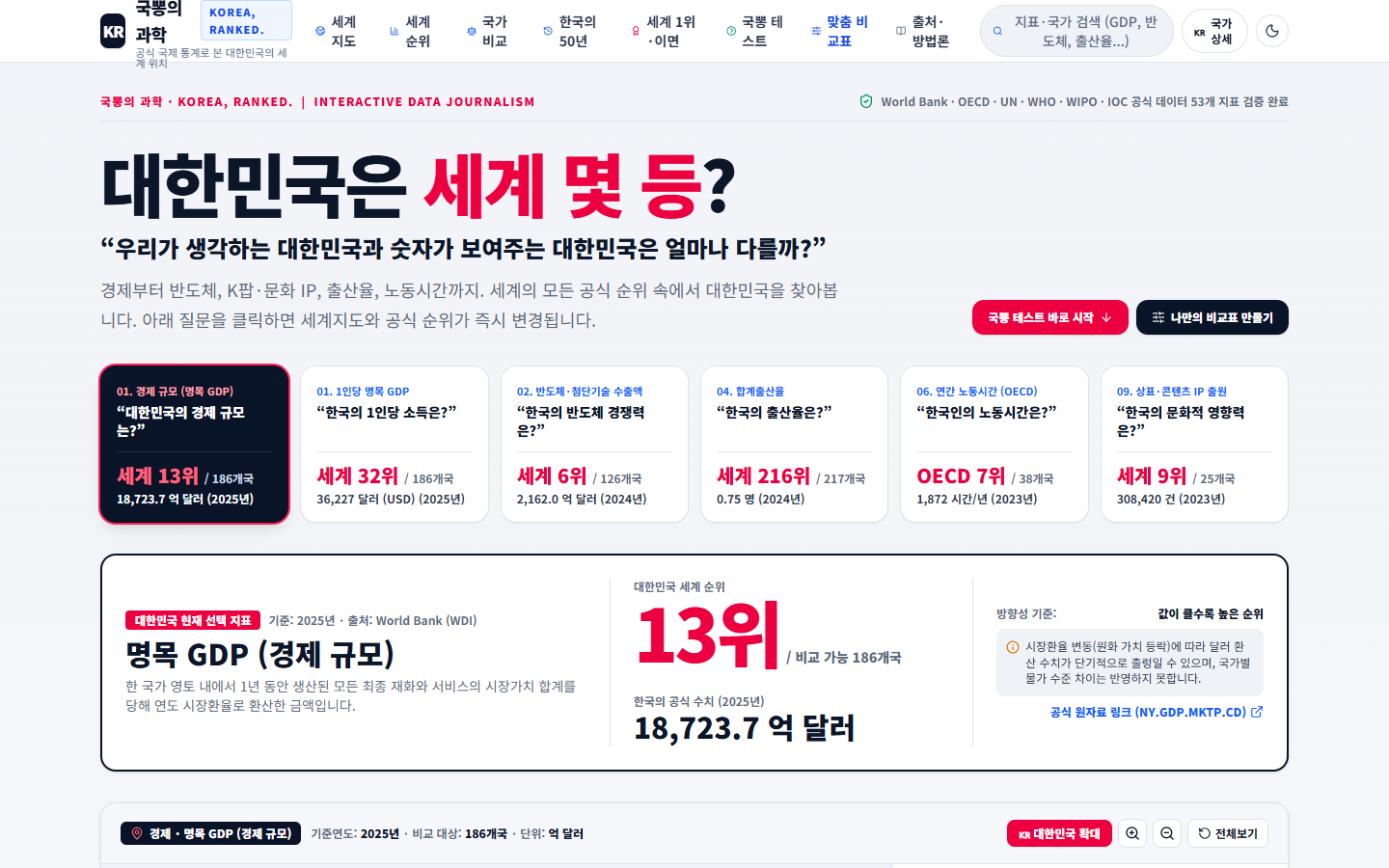
The question "Where does Korea rank in the world?" is often tossed around without context. Korea's economy is among the largest, yet it is also near the bottom in working hours, inequality, and suicide rate. Until you see all the indicators on one screen, it is hard to tell which side is the "fact."
We selected 53 indicators using only official sources from international organizations, and attached context explanations so they are not quoted selectively or interpreted arbitrarily. The title "K-Pride" (gukppong) means we should examine both excessive pride and excessive pessimism about Korea.
Data sources: only data officially published by the World Bank, OECD, WIPO, UNDP, IFR (International Federation of Robotics), IOC, WHO, ILO, and IMF is included. The number of countries compared varies by indicator.
What you can do
Filter by category — economy, technology, society, environment, sports — to see Korea's rank and value for the indicator you want.
Select up to 5 countries and compare them side by side across all 53 indicators. Filters based on G7 and OECD membership are also available.
See, year by year from 1973 to 2023, how Korea's rank changed on which indicators.
For each indicator, each country's rank and value are shown in color on a world map. Built on D3 Geo and TopoJSON.
An interactive quiz where you guess Korea's rank on 28 indicators, to find out "how much do I really know?"
Every indicator shows a link to the original source at the international organization and the latest reference year of the data.
Data and analysis methods
All data includes only raw data officially published by international organizations; secondarily processed statistics are not used. The data reference year varies by indicator (see each indicator's detail screen).
How to use it
Check Korea's rank on a specific indicator in an international comparison and get the official source right away.
Explore international comparison indicators interactively in social science and economics classes and understand 50 years of change.
Use the quiz to see how accurately you actually know Korea's rankings.
Technology and how it was made
Public APIs and download files from international organizations are cleaned with a Python pipeline and converted to JSON. It is rendered with Next.js and Tailwind CSS 4 and deployed on Vercel.
Development status
Includes 53 indicators. Planned to be updated once a year, in line with the international organizations' data refresh cycles.